DashForge
← All work

Homeowners

Upkeep

The reminder that carries the part number you used last time.

Home maintenance on intervals, with the record of what was actually done. Pick a house type and get a proposed schedule, mark a job done in one hand under a sink, and print the whole history for a buyer's surveyor.

CloudPremadeLive demo
Getting started
A proposed schedule

by house type, then edited

Every reminder
Carries the part

from the last time you did it

Overdue
Stays overdue

no silent reschedule, ever

What was going wrong

Everything in a house has an interval, and none of them are written down anywhere. The boiler service is remembered because it is annual and invoiced; the gutters, the smoke alarms, the water filter and the drain rods are remembered the day after they mattered. And when the reminder does arrive, it says "replace the water filter" without saying which one, so the job gets postponed to a day with a hardware shop in it.

What we built

Start from a schedule rather than an empty list — nobody wants to enumerate their own house. Then make the completion record carry the detail: what was done, when, what it cost, which part, with a photo. That record is what turns the next reminder into something actionable, and four years of it into a document a surveyor will read. Overdue is a state the app refuses to soften, because softening it is exactly how the six-year gutter happens.

What it looks like

Every screen shown on a desktop and on a phone, because half of these are used standing up.

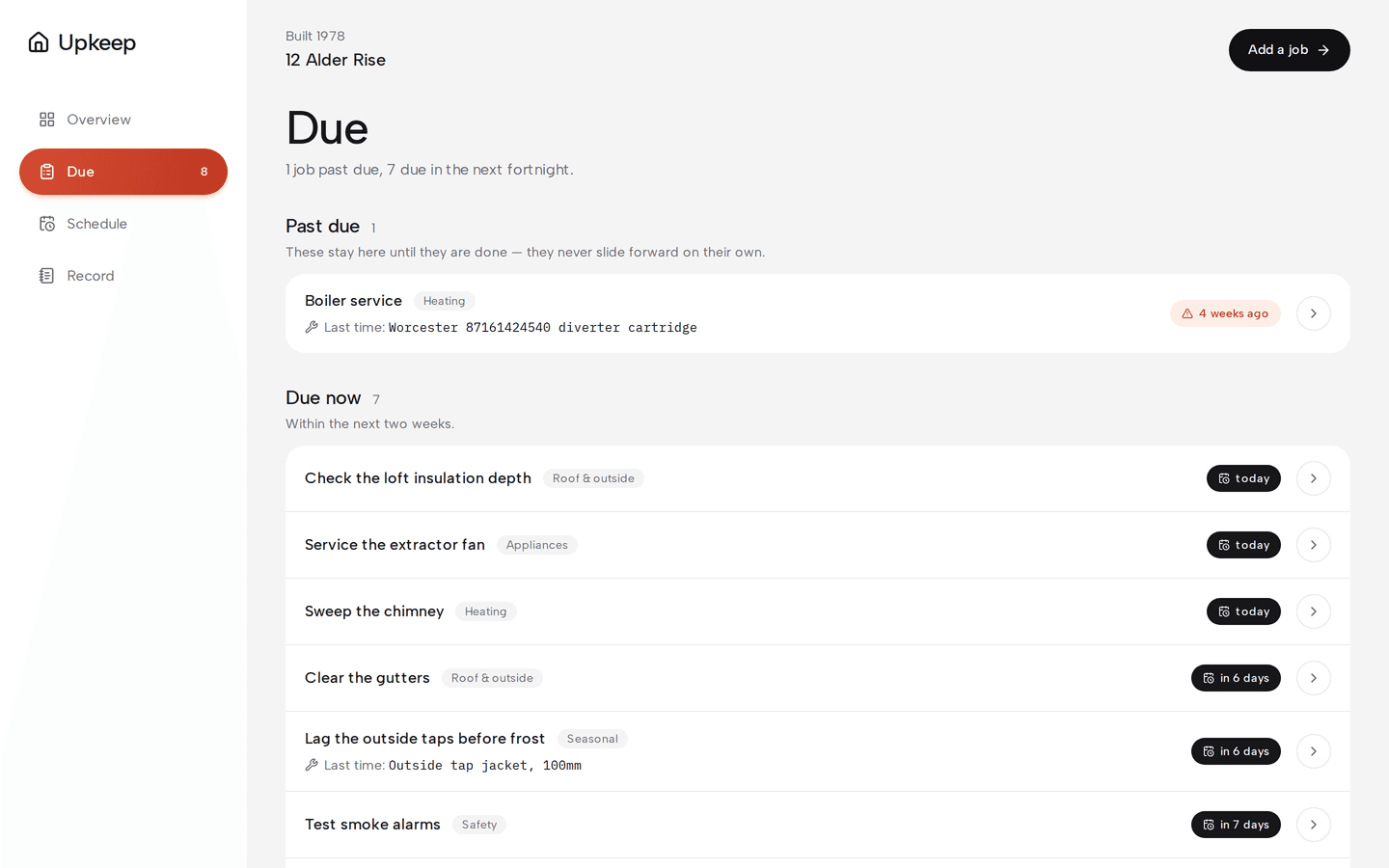
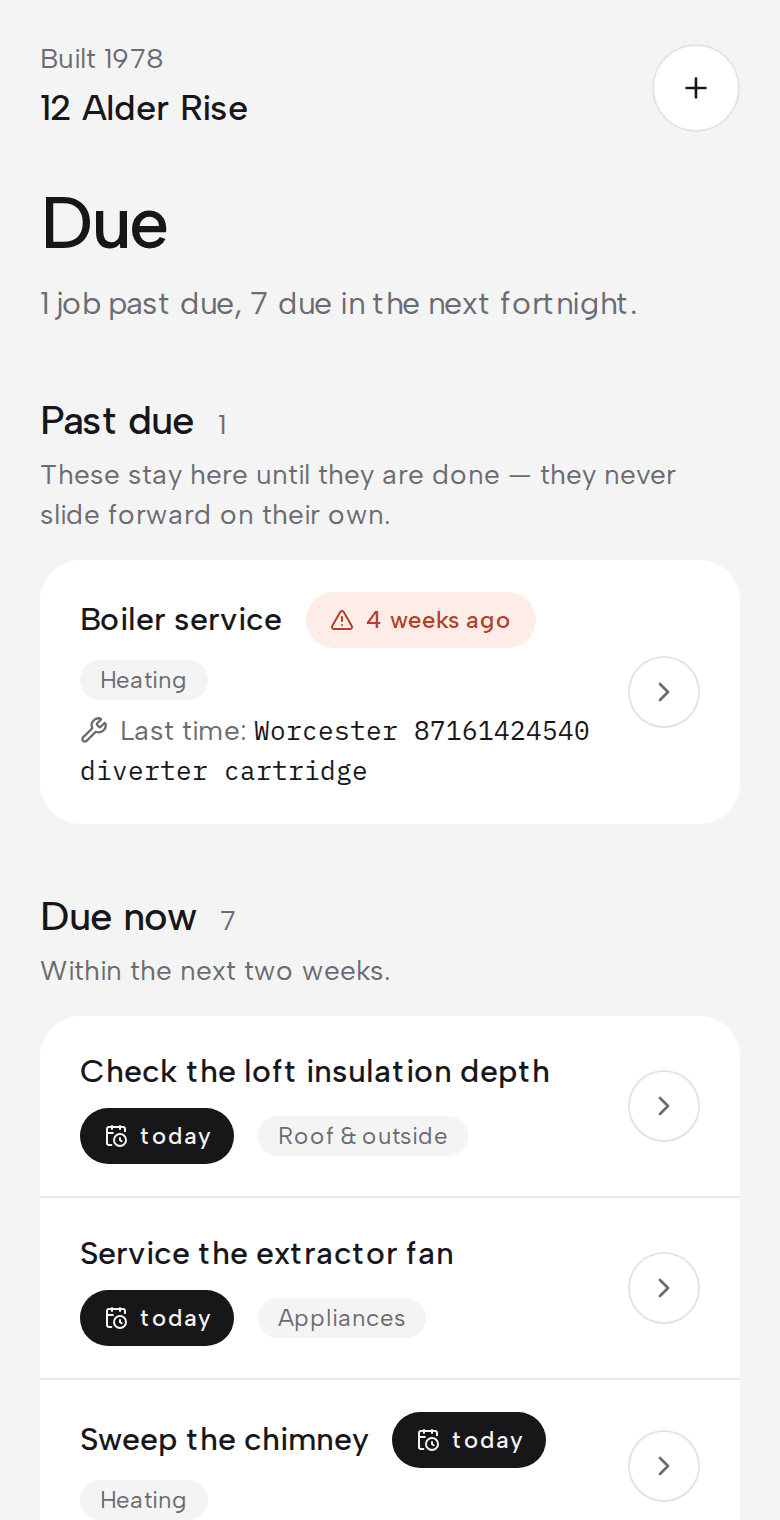
The house, today

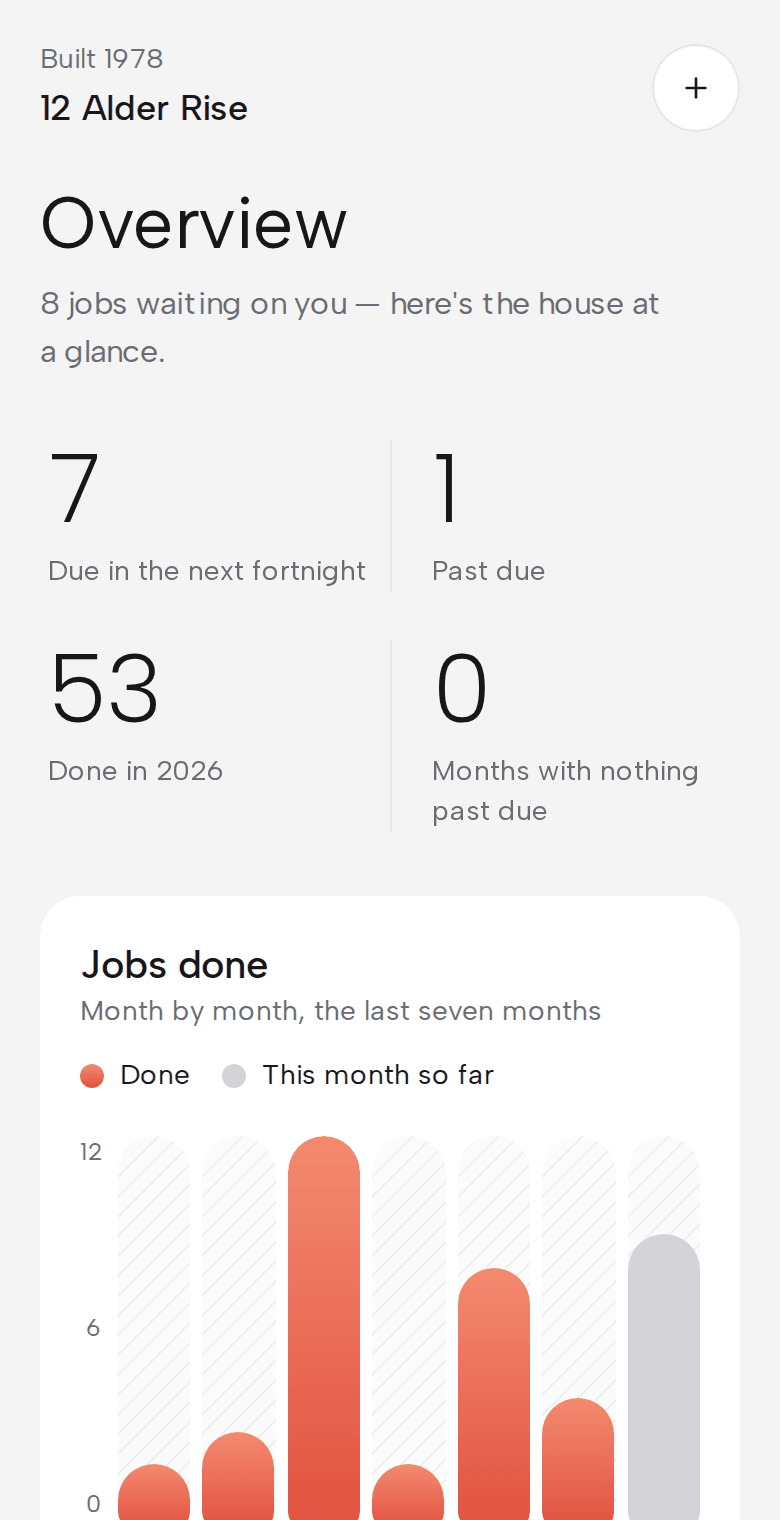
What is overdue, what is due, and what is coming — with the part number on the row rather than one level down.

/house

/house

Desktop capture

1440 × 900

9:41

Mobile capture

390 × 844

One job, and its history

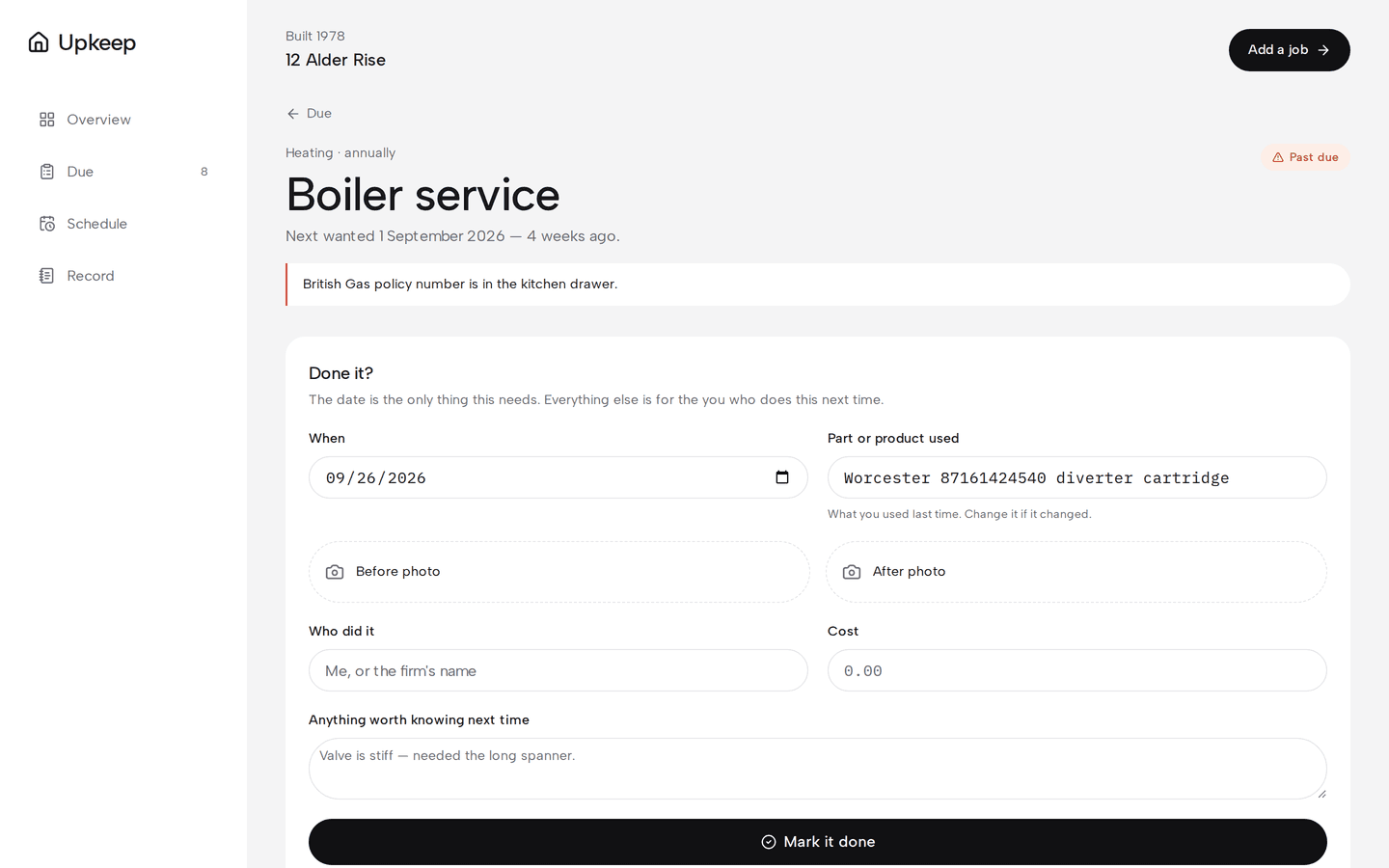
Mark it done in one hand under a sink. Everything past the date is optional, which is why the history is not empty.

/house/t/[id]

/house/t/[id]

Desktop capture

1440 × 900

9:41

Mobile capture

390 × 844

The schedule

Every job and how often, including the seasonal ones that anchor to a month rather than to a count of days.

/house/schedule

/house/schedule

Desktop capture

1440 × 900

9:41

Mobile capture

390 × 844

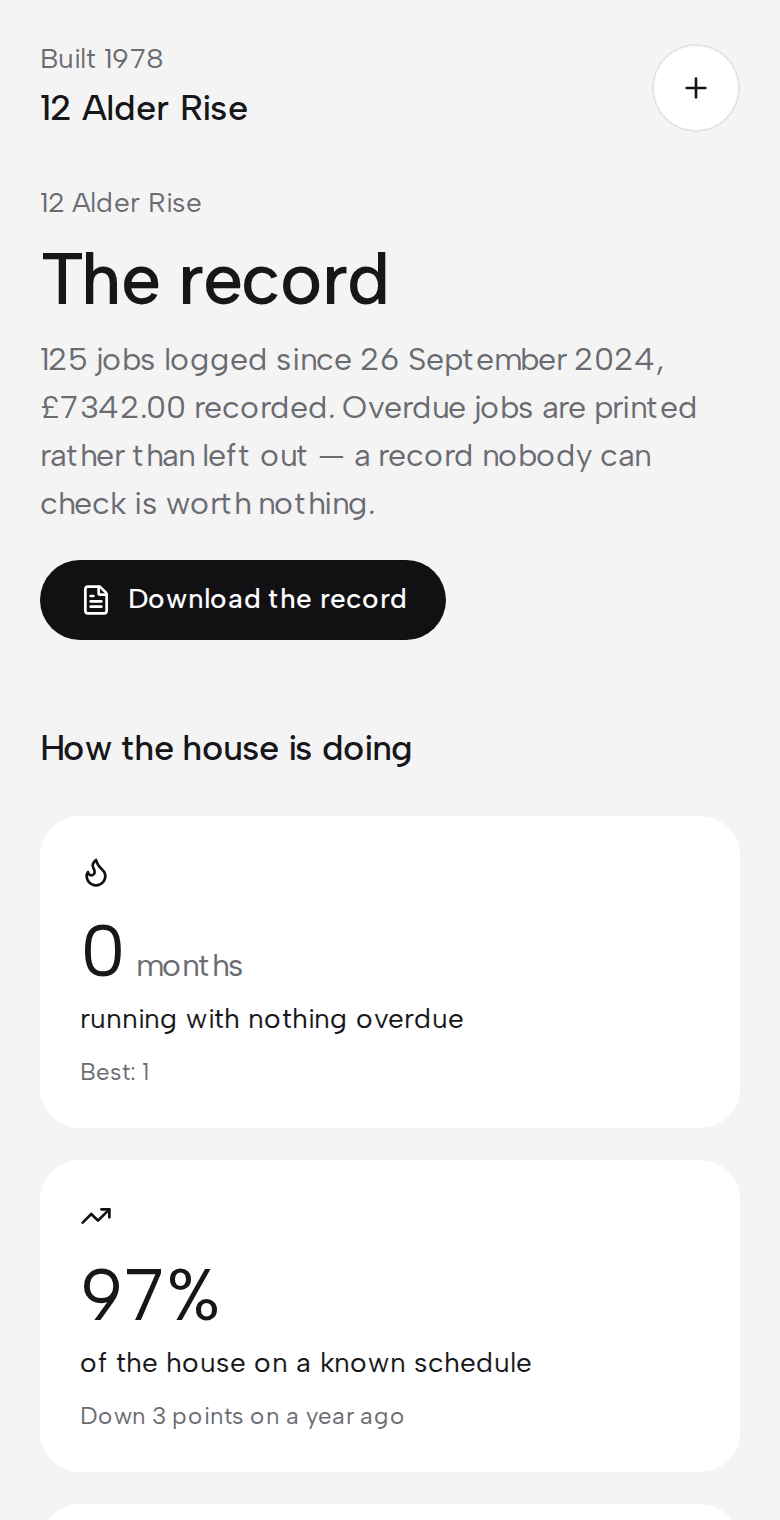
The record

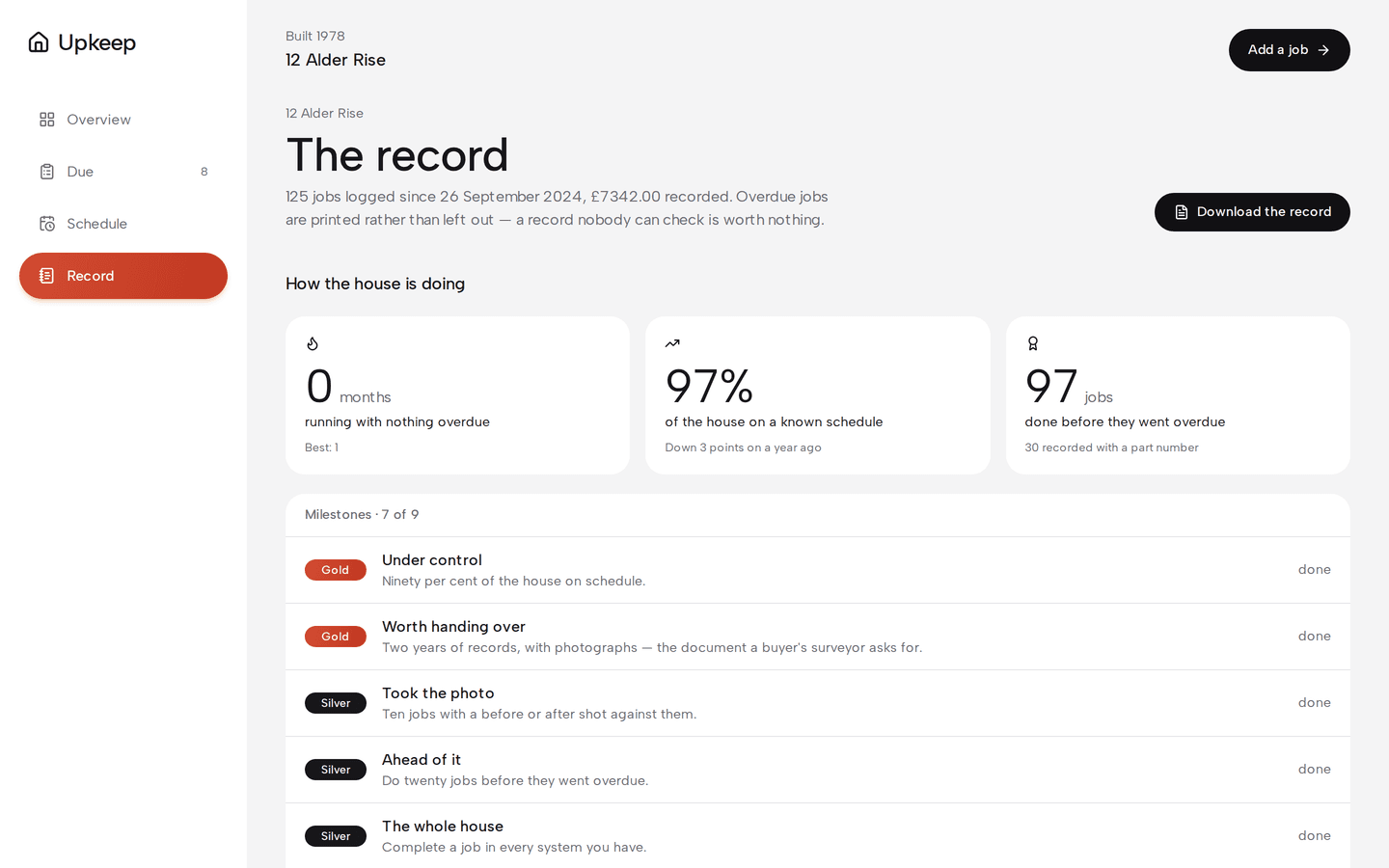
Four years of maintenance as a document, with photographs and part numbers. The thing you hand a surveyor.

/house/record

/house/record

Desktop capture

1440 × 900

9:41

Mobile capture

390 × 844

What it does

Who reaches for it, and when

A new owner in month one

Picks the house type, gets a schedule, and finds out the boiler service is already four months late.

Under the sink on a Saturday

Marks the filter changed and types the part number, one-handed, in about fifteen seconds.

Selling four years later

Hands over a document of everything that was done, with dates and photographs, instead of a shrug.

What makes this one different

  1. An overdue task stays overdue

    It does not roll forward and it does not go quiet. The gutters that were skipped for six years were skipped one quiet reschedule at a time, and any change that lets a due date move without a completion is wrong.

  2. The interval counts from when it was done

    Servicing a boiler two months late must not compress the next gap. Counting from the due date is how a schedule quietly drifts into being wrong.

  3. You cannot mark your own boiler fine

    A task's state is derived, and a nightly job is the only thing allowed to write it — the database grant revokes that column from ordinary users. The screens recompute live state at read time rather than trusting the stored value.

  4. One reminder per job, per due date

    Enforced by a unique constraint, not by hoping. An overdue task keeps its due date, so the second night produces nothing, and an app that mails you every morning about the same gutters gets filtered to a folder.

Built with

What each piece is doing here — the people who read this section are usually the ones who would have to maintain it after us.

Want something like Upkeep?

It does not have to be your industry — the underlying problem is nearly always the same. Tell us how the work moves through your business and we will tell you what it would take.

Every project is quoted on its own. Turnaround starts at two weeks.