DashForge
← All work

Tournament organisers

Gambit

Pairings you can defend, on a bracket that outlives the event.

Pairings and standings for chess clubs, card-game shops and fighting-game events. Swiss, round robin and double elimination with the tiebreaks always on screen, a public bracket that needs no account, and a player record that follows a person from event to event.

CloudCustomLive demo
Pairings
Reproducible

same seed, same draw, every time

Tiebreaks
Always visible

as columns, configured per event

The bracket
Public link

no account, outlives the event

What was going wrong

Club pairings were done in a program written in 1998 that runs on one laptop, or by hand on paper. Standings were photographed and posted to a group chat. When a player asked why they had been paired down, the honest answer was that nobody could reconstruct it, and that is the answer that makes people stop entering.

What we built

Treat the pairing engine as the product and everything else as an interface over it. It is pure code with no database, no clock and no unseeded randomness, so a draw can be reproduced from the published seed by anyone who doubts it. Tiebreaks are configured per event and always shown as columns. The public bracket is a link with no session behind it, which is what lets it outlive the day.

What it looks like

Every screen shown on a desktop and on a phone, because half of these are used standing up.

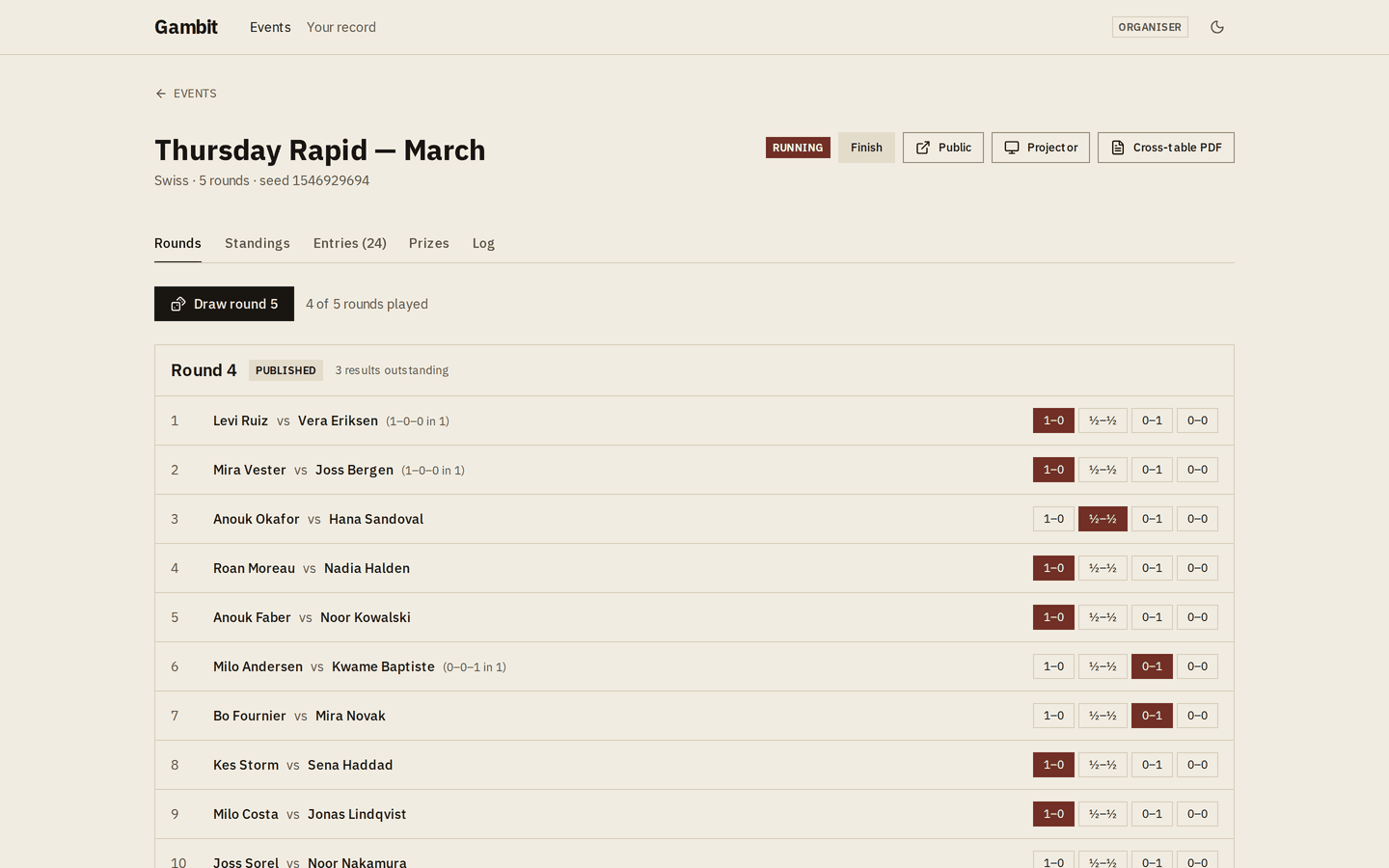
Running the event

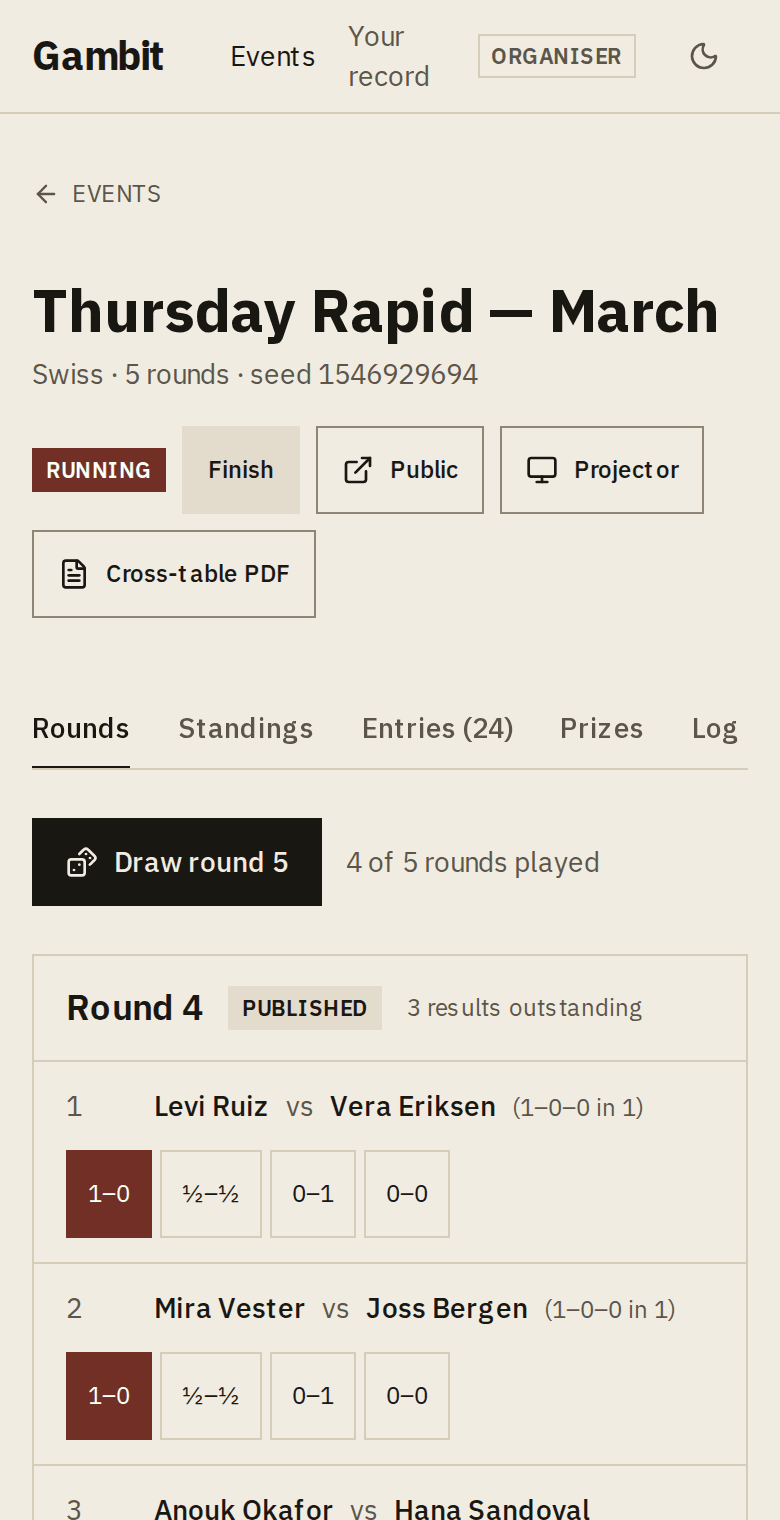
The organiser's screen between rounds — enter results, generate the next draw, publish when the room is ready.

/organise/[id]

/organise/[id]

Desktop capture

1440 × 900

9:41

Mobile capture

390 × 844

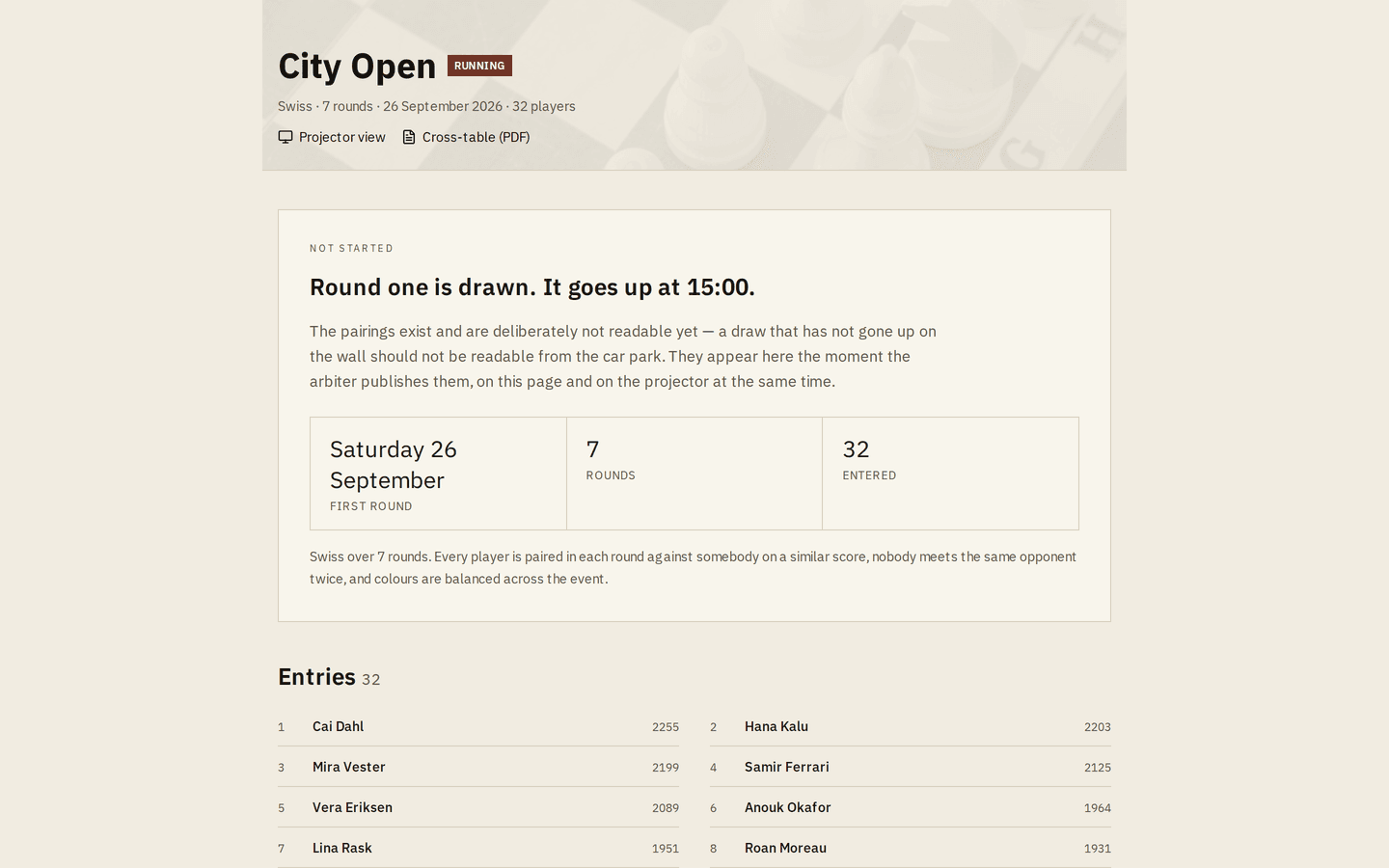
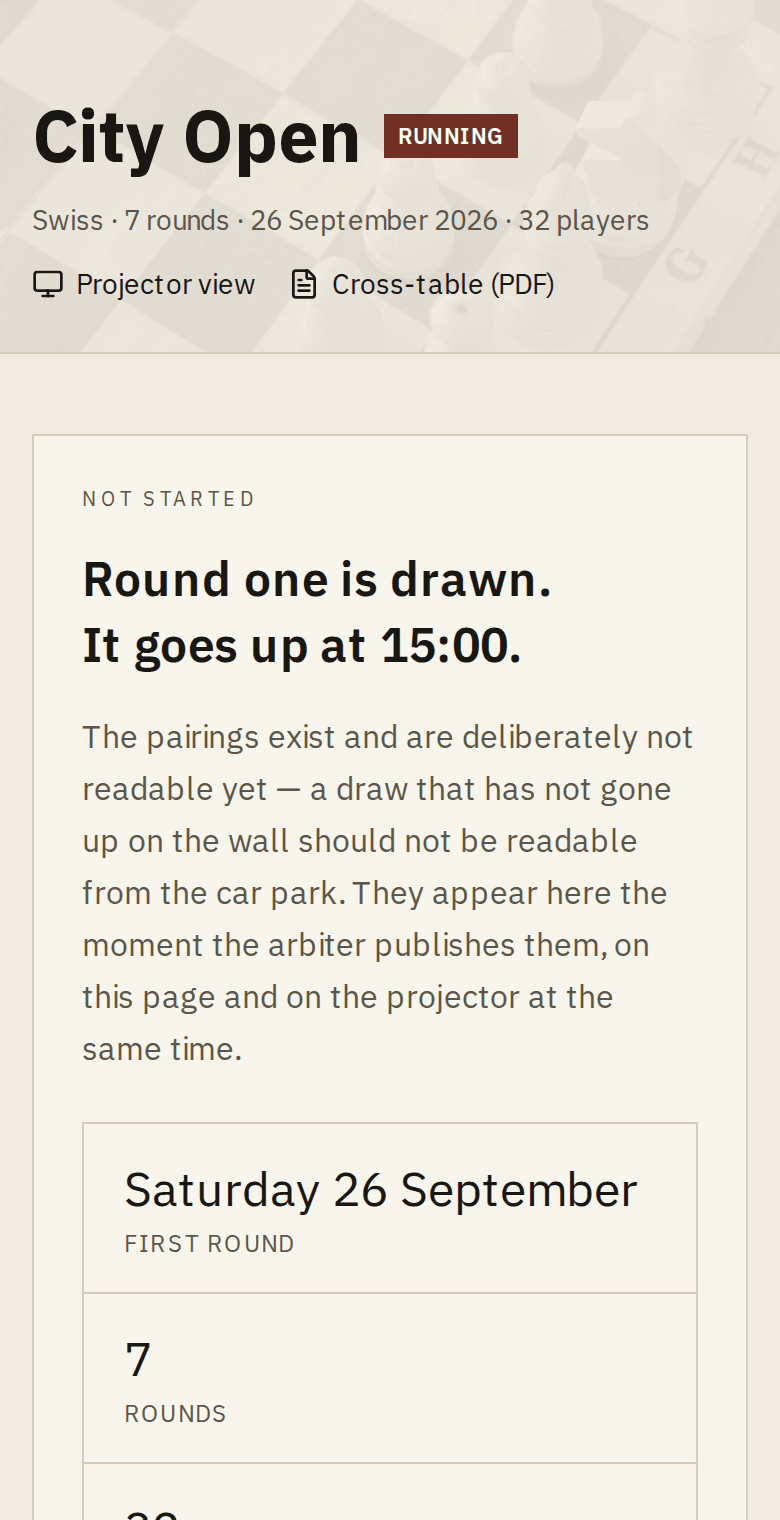
The public bracket

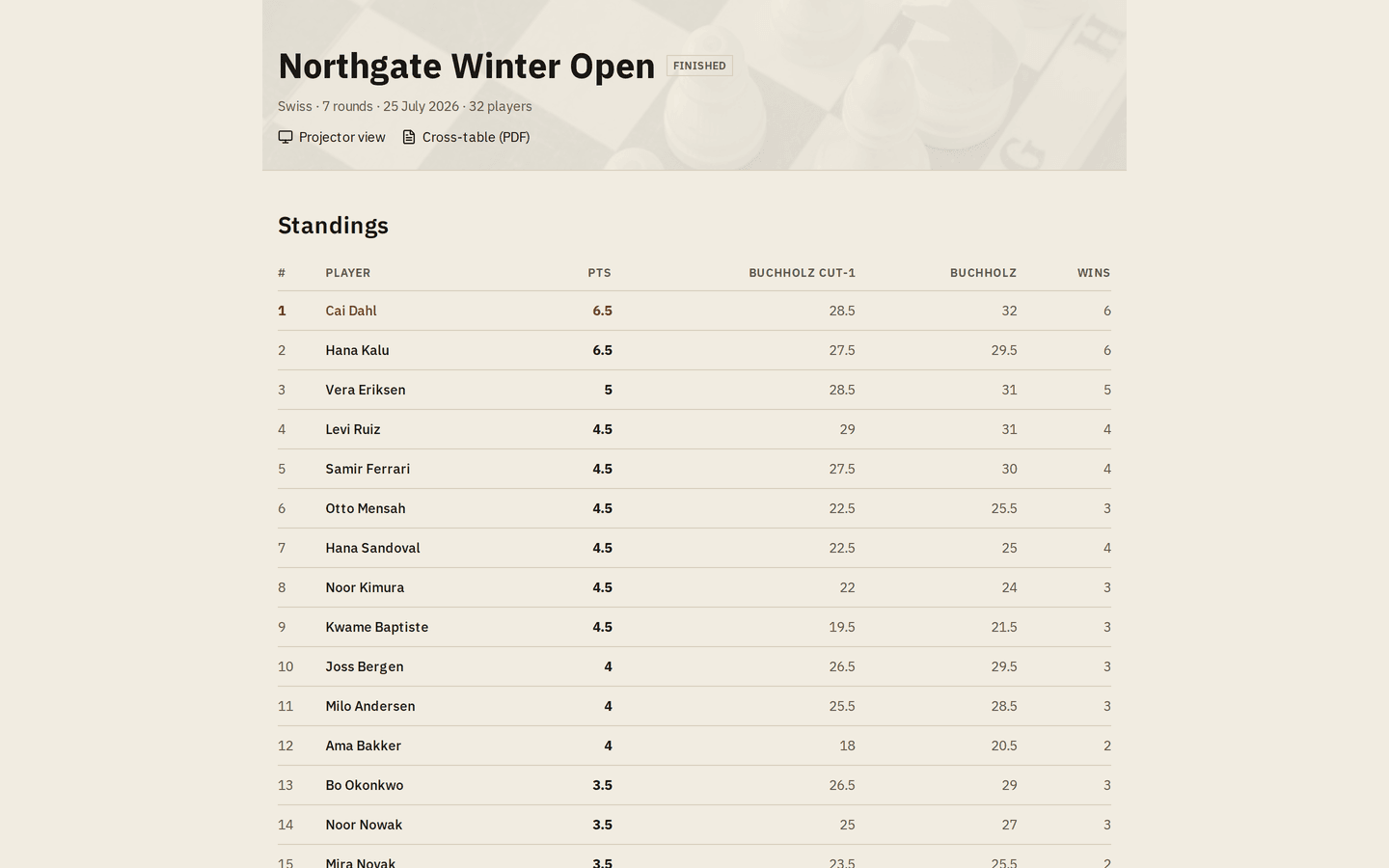
What gets pasted into the group chat. No account, no session, and it still resolves next year.

/e/[slug]

/e/[slug]

Desktop capture

1440 × 900

9:41

Mobile capture

390 × 844

The projector

Pairings, standings and the round clock, sized to be read from the back of a hall.

/e/[slug]/display

/e/[slug]/display

Desktop capture

1440 × 900

9:41

Mobile capture

390 × 844

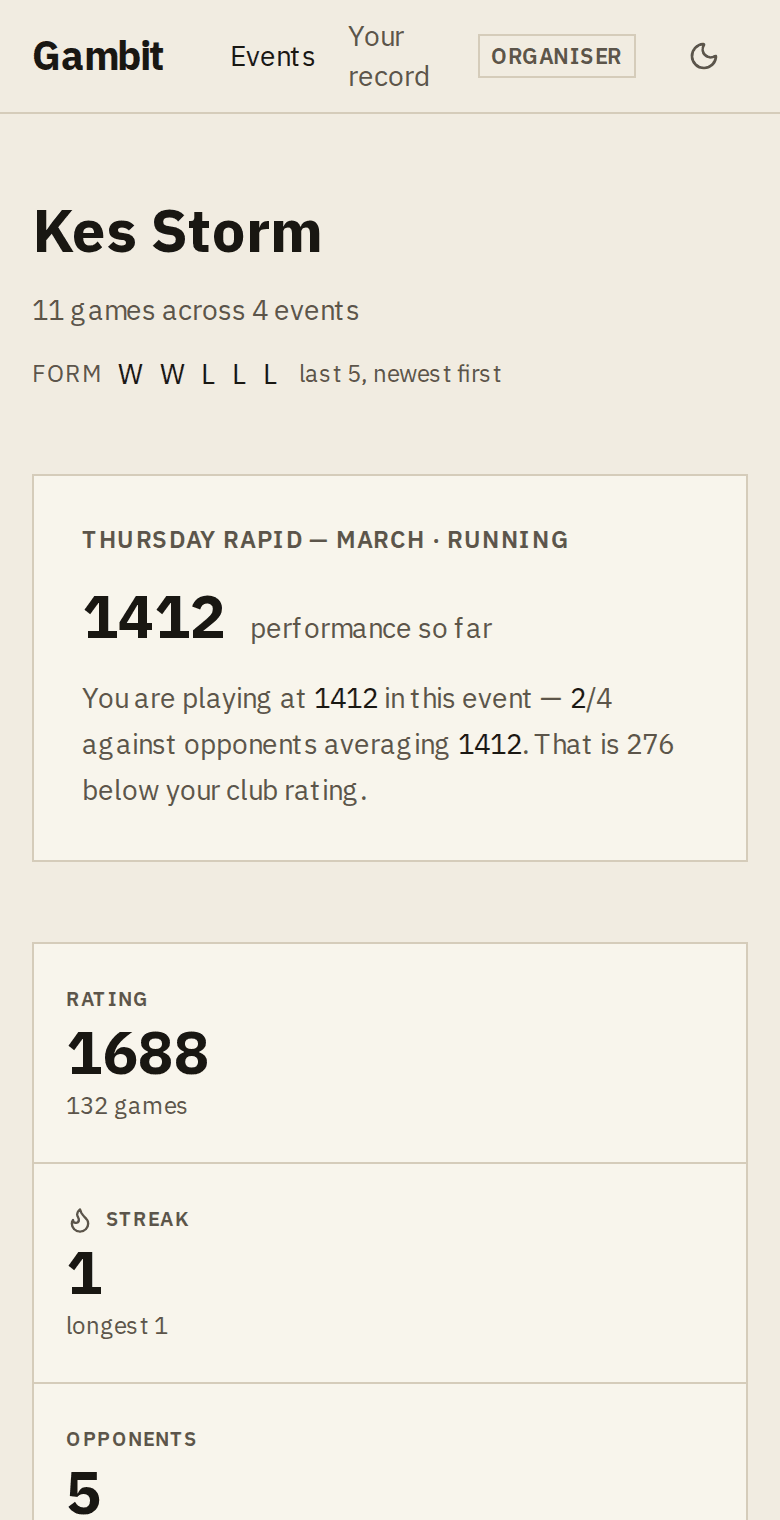
A player's record

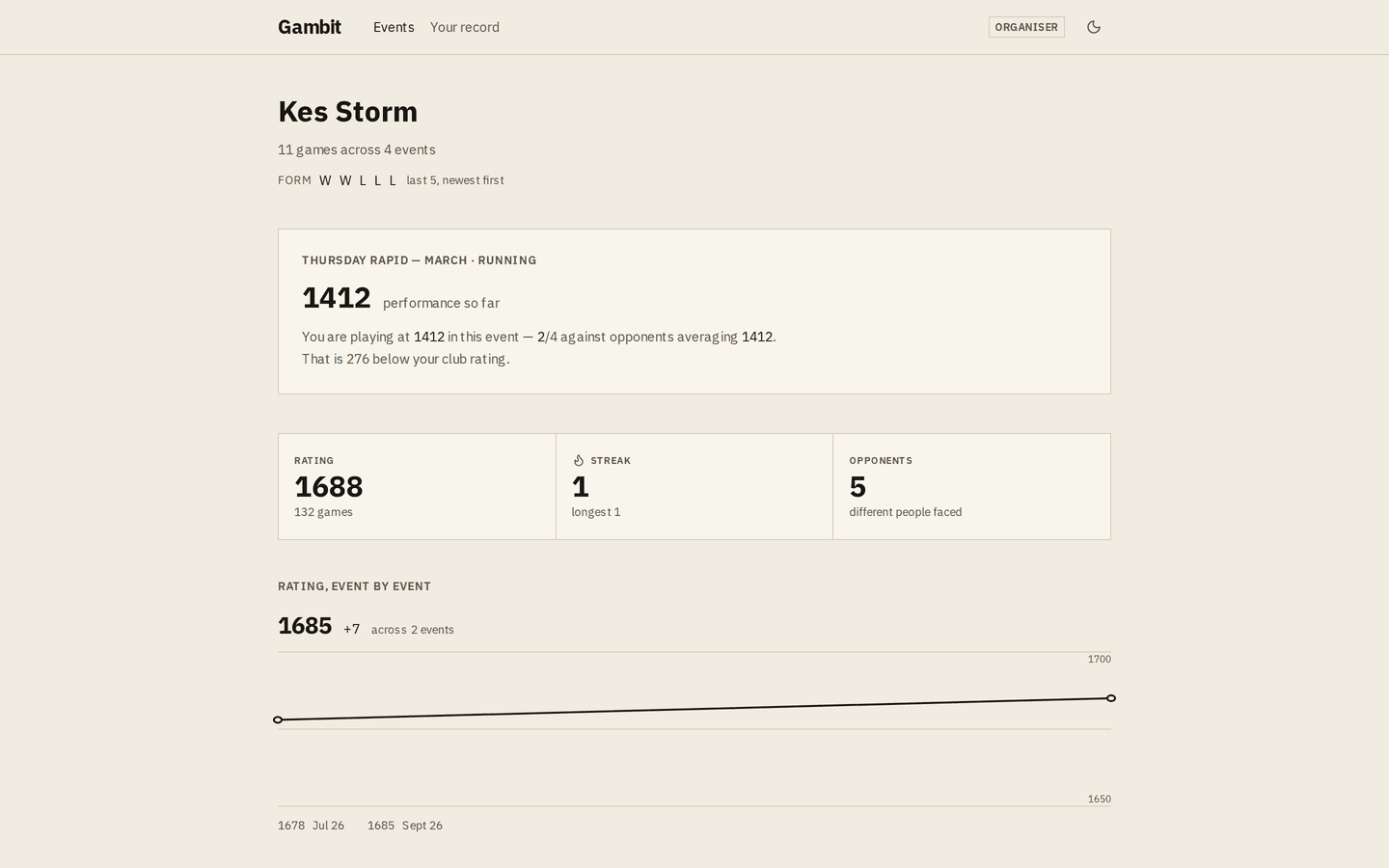
Rating across events, lifetime head-to-head, and the achievements that came off real results.

/me

/me

Desktop capture

1440 × 900

9:41

Mobile capture

390 × 844

What it does

Who reaches for it, and when

A club running a monthly Swiss

Types twenty names off a clipboard, pairs five rounds, and posts a cross-table by nine o'clock.

A card shop on a Saturday

Sixty-four players, published rounds only, and a bracket the room is watching on their own phones.

The player who got paired down

Opens the standings, sees the tiebreak columns, and gets an answer instead of a shrug.

What makes this one different

  1. Every draw is a function of the event's seed

    Same entries, same seed, same pairings — so "why was I paired against him again?" is answerable with a document rather than a shrug. There is no unseeded randomness anywhere in the draw.

  2. The Swiss pairer is minimum-cost matching

    Greedy score-group pairing cannot satisfy no-rematch, group cohesion and colour balance at once; three simpler attempts proved it before this one shipped. The engine is pure, has no database access at all, and is covered by tests.

  3. A bye is not a win

    Counting a bye as a defeated opponent inflates everyone else's Buchholz, and is the commonest way a cross-table stops being defensible. Withdrawing keeps a player's results for the same reason.

  4. Unpublished rounds are genuinely invisible

    The public view filters unpublished rounds *and* recomputes the standings from what is left. Filtering the rounds but keeping the standings is how results leak before the organiser is ready.

Built with

What each piece is doing here — the people who read this section are usually the ones who would have to maintain it after us.

Want something like Gambit?

It does not have to be your industry — the underlying problem is nearly always the same. Tell us how the work moves through your business and we will tell you what it would take.

Every project is quoted on its own. Turnaround starts at two weeks.